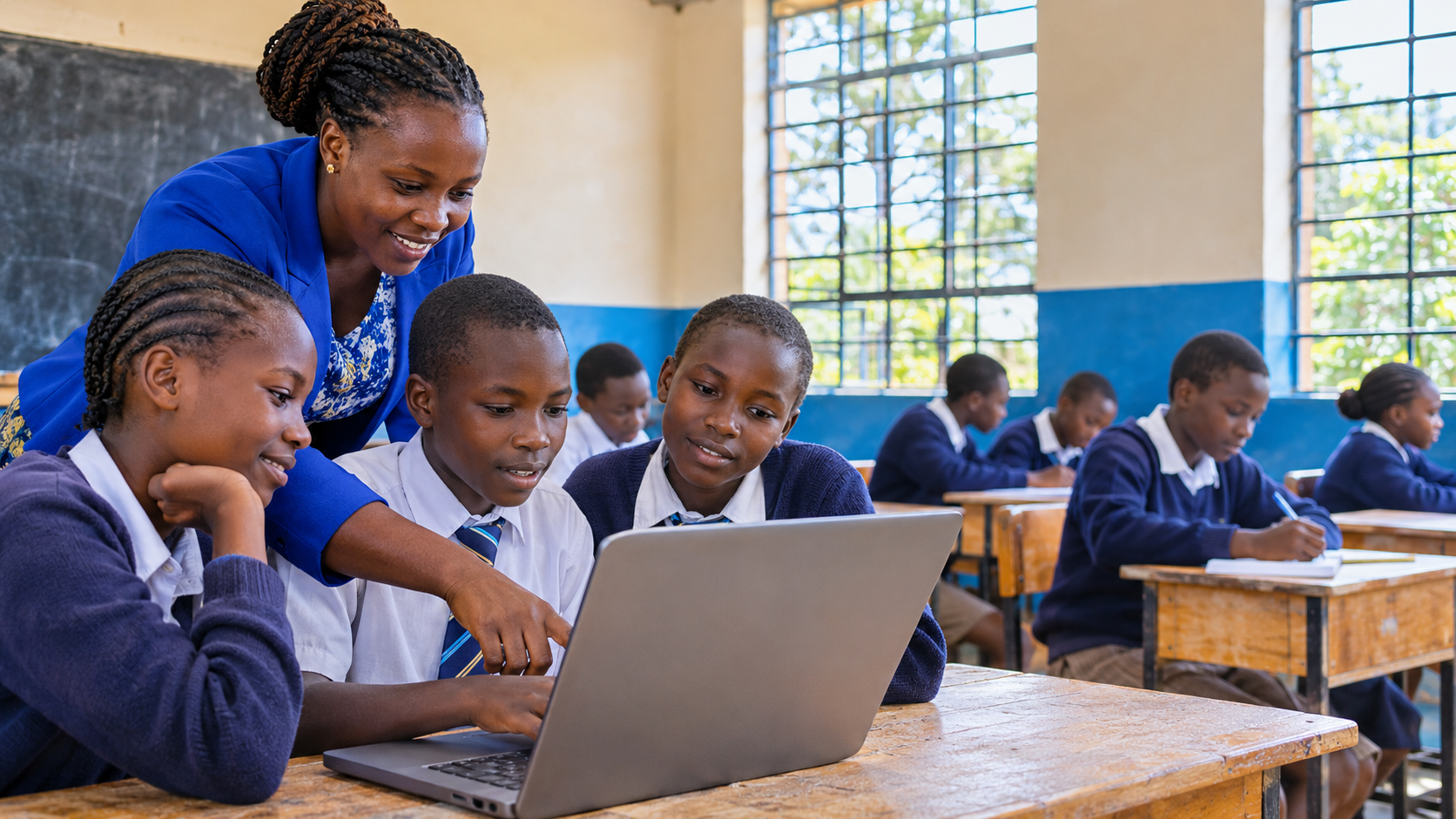
Google and Gates Foundation Bring AI-Powered Teaching Tools to Schools in Kenya, Ghana and South Africa
On this page
- What Has Google Announced?
- What Is Fab AI?
- What Are Gemma AI Models?
- What Will the AI Tools Help Teachers Do?
- How Many Teachers and Students Will Benefit?
- Will Teachers Receive Free AI Training?
- Could AI Improve Education in Kenya?
- What Are the Risks?
- QueryFun Take: Locally Designed AI Could Make Education More Accessible
- Frequently Asked Questions
Teachers in Kenya, Ghana and South Africa could soon receive new artificial intelligence tools designed to help them prepare lessons, assess students and improve classroom teaching.
On November 4, 2026, Google announced a partnership involving Google DeepMind, education nonprofit Fab AI and the Gates Foundation to develop AI-powered learning tools for schools across the three countries.
The initiative will focus on foundational literacy, helping students develop essential reading and learning skills.
Unlike many advanced AI systems that require expensive equipment, the proposed tools will use smaller AI models that can operate on more affordable devices.
Google says the first phase aims to support up to 500 teachers and 15,000 students.
The longer-term ambition is to reach more than two million learners.
However, these figures are targets, not the number of students who have already received the tools.
So how will the programme work, and what could it mean for education in Kenya?
What Has Google Announced?
According to Google’s November 4 announcement, Google DeepMind and Fab AI are working together to create specialised educational AI tools.
The programme will receive joint funding support from Google.org and the Gates Foundation.
Fab AI will lead a group of local innovators in Kenya, Ghana and South Africa.
These developers will work on technology designed for local classrooms rather than simply introducing generic AI chatbots.
Google DeepMind will contribute technical expertise and computing credits.
Computing credits help developers access the infrastructure needed to build and test AI systems.
The exact amount allocated specifically to this partnership has not been disclosed in the announcement.
What Is Fab AI?
Fab AI is a nonprofit organisation focused on improving education in low- and middle-income countries.
Its work involves developing technology that can support teaching and learning.
For this initiative, Fab AI will coordinate local developers working on educational applications.
This local involvement is important because educational needs differ between countries.
For example, a learning tool designed for a school in the United States may not match Kenya’s curriculum or the language needs of Ghanaian learners.
Local developers can help adapt AI systems to the realities of the classrooms where they will be used.
What Are Gemma AI Models?
The educational tools will be built using Google’s Gemma family of open models.
An AI model is a computer system trained to process information and generate responses.
Large AI systems can require substantial computing resources.
However, smaller models are designed to perform certain tasks using fewer resources.
Google says this makes it possible to develop applications that can operate on lower-cost devices.
For example, a teacher might use a specialised AI application to prepare reading exercises for a particular class.
The tool could be designed around local educational requirements without needing the same infrastructure as a large general-purpose AI model.
However, the announcement does not mean every application will work completely offline or on every smartphone.
Those capabilities will depend on how the tools are developed.
What Will the AI Tools Help Teachers Do?
The initiative focuses on three areas.
1. Preparing Better Lessons
Teachers spend considerable time planning classroom activities.
An AI tool could help prepare lesson outlines, reading exercises and practice questions aligned with the national curriculum.
For example, a teacher preparing an English lesson might use an AI assistant to generate several reading activities suitable for a particular age group.
The teacher could then review the suggestions and choose the most appropriate material.
The aim is to support lesson preparation, not remove teachers from the process.
2. Assessing Student Understanding
Students learn at different speeds.
Some may understand a topic immediately, while others need additional explanations.
AI-powered assessment tools could help teachers identify areas where students are struggling.
For example, if several students repeatedly make the same mistake in a reading exercise, the system might highlight the problem.
The teacher could then provide additional instruction.
However, these systems will need proper testing to ensure they produce reliable feedback.
3. Supporting Teacher Development
The initiative will also explore AI-powered coaching.
Teacher coaching involves providing educators with constructive feedback to help them improve their teaching methods.
For example, a teacher might receive suggestions about how to ask more effective questions or encourage greater student participation.
AI could provide additional guidance between formal training sessions.
However, such systems should complement human mentors and professional development programmes.
How Many Teachers and Students Will Benefit?
Google has outlined two levels of ambition.
The first phase aims to support up to 500 teachers and 15,000 students.
If the programme proves successful and can be expanded, Google says it could potentially reach more than two million learners.
The announcement does not specify how the initial beneficiaries will be divided among Kenya, Ghana and South Africa.
It also does not provide a confirmed list of participating schools.
Therefore, it would be inaccurate to claim the tools are already available nationwide.
Will Teachers Receive Free AI Training?
Google is also expanding its AI Educator Series across sub-Saharan Africa.
This is a separate but related training programme designed to help teachers use AI responsibly.
The training covers practical activities such as lesson planning, creating assessments and reducing administrative work.
According to Google, the regional rollout will begin in South Africa through a partnership with the South African Council for Educators.
Expansion to Kenya, Ghana and Nigeria is planned for 2027.
This means Kenyan teachers should not assume the full programme has already launched locally.
Google says participants will be able to earn micro-credentials through the training.
A micro-credential is a recognition of completing a particular learning activity or demonstrating a specific skill.
Could AI Improve Education in Kenya?
Kenyan schools face different challenges depending on their location and available resources.
Some schools have access to computers, reliable internet and digital learning platforms.
Others operate with limited technology and large classes.
Smaller AI models could offer opportunities to develop more affordable educational tools.
For example, a teacher in a resource-constrained classroom might eventually use an AI application to generate additional reading exercises.
However, a successful rollout would require more than software.
Schools would still need suitable devices, teacher training, reliable electricity and clear rules for protecting student information.
The tools would also need to reflect Kenya’s curriculum and educational standards.
What Are the Risks?
AI systems can produce incorrect or misleading information.
An AI-generated reading exercise might contain mistakes.
An assessment tool might misunderstand why a student answered a question incorrectly.
Teachers must therefore remain responsible for reviewing the materials and interpreting student performance.
Privacy is another consideration.
Educational applications may handle information about minors.
Developers and schools must ensure that appropriate data protection measures are in place.
Accessibility is equally important.
A programme intended to reduce educational inequality should not leave behind schools that cannot afford internet access or compatible devices.
QueryFun Take: Locally Designed AI Could Make Education More Accessible
The most promising part of this initiative is its focus on local developers and smaller AI models.
Rather than assuming one global AI tool will work equally well in every classroom, Google and its partners are supporting technology adapted to different educational environments.
That approach could be useful in Kenya, where schools have different resources and learning needs.
However, the initiative is still at an early stage.
The real measure of success will be whether the technology helps students improve their learning outcomes.
AI should support teachers, not replace their professional judgment.
Frequently Asked Questions
Is Google launching AI education tools in Kenya?
Google has announced a development programme covering Kenya, Ghana and South Africa. It is not yet a nationwide rollout.
Who is funding the programme?
The initiative receives joint funding support from Google.org and the Gates Foundation.
What is Fab AI?
Fab AI is a nonprofit organisation that develops education technology for low- and middle-income countries.
How many students will benefit?
The first phase aims to support up to 15,000 students and 500 teachers. More than two million learners is a potential longer-term reach.
Will the AI tools work on smartphones?
The programme focuses on smaller models suitable for lower-cost devices, but specific device compatibility has not yet been confirmed.
When will Google AI teacher training reach Kenya?
Google plans to expand its AI Educator Series to Kenya in 2027.
Can Kenyan teachers register now?
The announcement does not provide a confirmed Kenya-specific registration process for the new tools.
Will AI replace teachers?
The initiative is designed to support teachers with planning, assessment and professional development, not replace them.